
Dates and The Sacred Islamic Culture
This article is about religious and cultural tradition. The few nutrition notes in it are general information, not medical advice.
Introduction
Among all fruits revered across history, few possess as profound a spiritual and cultural meaning as the dates fruit in Islam. For more than fourteen centuries Muslims have eaten dates as ordinary food and as part of worship. The Prophet ﷺ broke his fast with them, and the date palm appears in a number of verses of the Qur’an. Here is all about Dates and Islamic Culture.
From the deserts of Arabia to homes across the Muslim world today, the tradition of eating dates — especially during Ramadan — continues to unite millions in a shared act of devotion and gratitude. The fruit’s mention in the Qur’an and Hadith (sayings of the Prophet Muhammad ﷺ) further elevates its status, making dates a sacred element of Islamic life and ritual.
This article explores why dates hold such deep significance in Islamic culture — from their historical origins and spiritual symbolism to their continued role in religious practices and modern Muslim identity.
The historical roots of dates in Islamic civilisation
The cultivation and consumption of dates trace back thousands of years, particularly in the Arabian Peninsula, where the harsh desert climate made the date palm one of the few plants that could thrive. Known as the “Tree of Life,” the date palm provided food, shade, and building materials — sustaining life in one of the world’s most arid regions.
When Islam emerged in the 7th century, the date palm naturally became intertwined with the religion’s cultural and spiritual identity. It was not just a plant but a divine provision — a sustenance that connected human life to divine creation.
The Qur’an mentions date palms and dates in a number of verses, often as part of God’s provision for people. As a result, dates became not only a staple food but also a spiritual symbol of sustenance, resilience, and faith.
Dates in the Qur’an
The Qur’an mentions dates in several verses, emphasizing their importance as both nourishment and a sign of Allah’s bounty. For instance:
“And shake the trunk of this palm tree towards you, it will drop fresh, ripe dates upon you.”
(Surah Maryam 19:25, The Clear Quran on quran.com)
The verse is part of the story of Maryam (Mary), the mother of Prophet Isa (Jesus). “The pains of labour drove her to the trunk of a palm tree” (19:23). She is told to shake the palm for fresh dates, and then: “So eat and drink, and put your heart at ease” (19:26). Muslims read the passage as comfort and provision from God at a very hard moment, and it is one reason dates are linked with sustenance in times of hardship.
Palm trees also appear in the Qur’an’s description of the gardens of paradise: “In both will be fruit, palm trees, and pomegranates” (Surah Ar-Rahman 55:68). For many believers the fruit thus represents both earthly sustenance and heavenly reward, reminding believers of the connection between gratitude and divine blessing.
The Prophet Muhammad ﷺ and the Sunnah of dates
The Prophet Muhammad ﷺ frequently consumed and recommended dates, further cementing their religious significance. His habits, known as Sunnah, serve as a model for Muslims worldwide, and dates feature prominently in many of them.
Breaking the fast with dates
One of the most well-known traditions is the Prophet’s practice of breaking his fast with fresh or dry dates and water.
“The Messenger of Allah (ﷺ) used to break his fast before praying with some fresh dates; but if there were no fresh dates, he had a few dry dates, and if there were no dry dates, he took some mouthfuls of water.”
(Narrated by Anas ibn Malik. Sunan Abi Dawud 2356, Book 14, Hadith 44; graded hasan sahih by al-Albani)
The hadith records what the Prophet ﷺ did, nothing more. Muslims follow it as Sunnah, and many see in it gratitude, balance, and simplicity. On the practical side, dates are mostly natural sugar (about 63 to 66 g per 100 g in USDA data for Medjool and Deglet Noor), so they are an easy first food after a day without eating.
Dates and charity
The Prophet ﷺ also urged charity (sadaqah), even when all a person can give is part of a date:
“Save yourself from Hell-fire even by giving half a date-fruit in charity.”
(Narrated by ʿAdi bin Hatim. Sahih al-Bukhari 1417, Book 24, Hadith 21)
This Hadith highlights the spiritual weight of generosity: no gift is too small to count.
Ajwa dates in the hadith
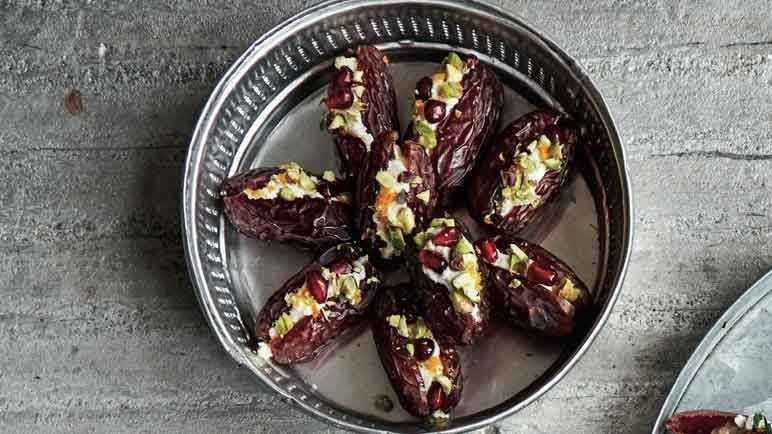
Among the many types of dates, kurma ajwa is the variety named in a well-known hadith: “He who eats seven ‘Ajwa dates every morning, will not be affected by poison or magic on the day he eats them” (narrated by Saʿd, Sahih al-Bukhari 5445, Book 70, Hadith 74). That is the whole of the hadith’s wording; it does not speak of illness in general, and it is not a medical claim. Today, Ajwa dates remain one of the most sought-after varieties, often bought as a Sunnah food.
The role of dates during Ramadan
Ramadan, the holiest month in Islam, is a time of fasting, reflection, and spiritual renewal. Dates hold a central place in this sacred month.
At sunset, Muslims around the world break their fast with dates, following the Prophet’s example. This moment — known as Iftar — is one of the most cherished experiences of Ramadan.
The significance lies not only in the act itself but in what it represents:
- Gratitude for Allah’s sustenance.
- Unity among Muslims worldwide.
- Reflection on simplicity and humility.
The sweetness of the date marks the transition from hunger to fulfillment, symbolizing the sweetness of faith after patience and devotion.
Dates also suit the moment in a plain, practical way. Per 100 g they have about 277 to 282 kcal, 63 to 66 g of natural sugars and 6.7 to 8 g of fibre (USDA FoodData Central, Medjool and Deglet Noor), so a few dates are a quick, gentle start before the main meal.
Dates in other Islamic traditions and ceremonies
Birth and the Sunnah of Tahneek

In Islamic tradition, when a baby is born, a small piece of softened date is rubbed on the newborn’s palate — a ritual known as Tahneek.
The Prophet ﷺ did this himself. Abu Musa reported: “A son was born to me and I took him to the Prophet (ﷺ) who named him Ibrahim, did Tahnik for him with a date, invoked Allah to bless him and returned him to me” (Sahih al-Bukhari 5467, Book 71, Hadith 1). Many families see it as beginning a child’s life with sweetness and a prayer, in the belief that every life should begin with nourishment and faith.
Marriage and festive occasions
Dates are also served during weddings, Eid celebrations, and religious gatherings, symbolizing joy, prosperity, and gratitude. Offering dates to guests represents hospitality and goodwill, a tradition deeply rooted in Islamic etiquette.
Funerals and acts of charity
In some communities, dates are given out as charity on behalf of someone who has died. The practice of giving on behalf of the dead goes back to a hadith in which a man asked whether he could give charity for his late mother, and the Prophet ﷺ answered, “Yes! Give in charity on her behalf” (Sahih al-Bukhari 2760, Book 55, Hadith 23).
Cultural symbolism of dates in the Muslim world
Beyond their religious role, dates have become a profound cultural emblem across Muslim societies. From Morocco to Malaysia, the fruit signifies generosity, community, and divine favor.
In Arab culture, offering dates to visitors is an age-old gesture of welcome and respect. In South and Southeast Asia, including Malaysia, Indonesia, and Pakistan, dates are integral to festive tables during Eid al-Fitr and Eid al-Adha.
Different varieties carry different cultural prestige — kurma medjool is prized for its large, luxurious size and rich flavor, often gifted during special occasions, while kurma mariami is cherished for its caramel sweetness and smooth texture. These varieties represent not just culinary taste but also social tradition and connection.
A symbol of unity across the Muslim ummah
Dates transcend geography, language, and ethnicity — serving as a universal symbol of unity among Muslims. During Ramadan, Muslims across the globe break their fast with the same fruit as sunset reaches each town, reinforcing a sense of shared faith and belonging.
Whether in a small village mosque or a grand city iftar, the presence of dates creates a spiritual link between communities. It reminds believers that Islam emphasizes simplicity, equality, and gratitude — values embodied in a humble fruit.
This unity through simplicity is one of the most beautiful aspects of Islamic culture, showing how a single tradition can connect hearts worldwide.
The symbolism of dates beyond food
Muslims read several meanings into the date. Eating it the way the Prophet ﷺ did is a way of following the Sunnah. It is a plain, whole food named in the Qur’an, and the palm grows where few other plants can, which many compare to faith that holds up under trial. Even part of a date counts as charity, as the hadith above says. Breaking the fast on dates together at iftar is a large part of what makes Ramadan feel shared, and eating one is a small moment to thank Allah for what He provides.

The economic and ethical role of dates in Muslim societies
The spiritual significance of dates also translates into their economic and ethical importance. Many Muslim-majority countries, such as Saudi Arabia, Egypt, Iran, and Tunisia, rely on date cultivation as a key agricultural activity.
Farmers and traders who deal in dates often view their work as part of a divinely blessed livelihood, rooted in centuries of tradition. The trade in dates — whether local or international — sustains families and communities, linking faith with ethical commerce.
Today Ajwa, Medjool and Mariami are sold far from where they grow, Malaysia included.
Dates in modern Islamic life
Even in the modern age, dates remain central to Islamic life — though their presence has evolved with technology and globalization. Today, dates are available worldwide, often sold online and delivered across continents, allowing Muslims everywhere to uphold their traditions.
Many shoppers also buy dates as an everyday snack with fibre and natural sugar in place of sweets. That mix of faith and everyday food makes dates relevant not just in religion but in modern lifestyles centered on mindfulness and balance.
Furthermore, contemporary Muslim households often incorporate a range of date-based products — syrups, spreads, and smoothies — blending tradition with innovation.
Conclusion
Dates run through Muslim life in concrete ways. They break the fast at iftar, as the Prophet ﷺ did. A softened piece is used for Tahneek when a baby is born. Even part of a date counts as charity, and in some communities dates are given out on behalf of someone who has died.
The fruit itself is simple. What gives it weight is the practice built around it, carried from the Prophet’s time to Malaysian homes today.
References
- Qur’an, Surah Maryam 19:23, 19:25, 19:26; Surah Ar-Rahman 55:68 (The Clear Quran translation, quran.com).
- Sunan Abi Dawud 2356 (Book 14, Hadith 44), breaking the fast with dates.
- Sahih al-Bukhari 1417 (Book 24, Hadith 21), half a date in charity.
- Sahih al-Bukhari 5445 (Book 70, Hadith 74), seven Ajwa dates.
- Sahih al-Bukhari 5467 (Book 71, Hadith 1), Tahnik with a date.
- Sahih al-Bukhari 2760 (Book 55, Hadith 23), charity on behalf of the dead.
- USDA FoodData Central: Dates, medjool (168191); Dates, deglet noor (171726).