
Unique Date Varieties at Kedai Kurma
Every box of dates on a kedai kurma shelf in Malaysia was imported, because Malaysia has no commercial date-growing trade. If you only know Medjool and the stalk-on Deglet Noor, the rest of the shelf is worth a look. On the list we checked, every other in-stock variety had a lower harga kurma per kilo than Medjool. This guide walks through the varieties you are likely to meet, where each one comes from, how it eats, and what one Malaysian wholesaler was charging for them when we checked the list in November 2026.
How many date varieties are there?
Hundreds in some countries, going by FAO. The FAO handbook Date Palm Cultivation (Plant Production Paper 156) has a table of the number of varieties described per country: 400 for Iran (FAO, 1996), 370 for Iraq (Dowson, 1923), 250 for Tunisia (Kearney, 1906) and 244 for Morocco (Saaidi, 1974). Those are varieties described by researchers, not varieties for sale, and a shop stocks only a small share of them.
So “unique” at a kedai kurma really means a variety you have not tried yet. Below are the varieties on the wholesaler list we checked, a few well-known names that had no pack on it, and two rarer ones, Barhee and Halawi.

The two names everyone knows
Medjool
Medjool originated in Morocco. FAO traces it to the Tafilalet area, where it was the main export date from the 17th century. The Medjool packs on the list we checked are labelled Palestine, and the fruit is large, very soft and tastes of caramel. One detail in the FAO description is worth knowing: “although classified as a soft date, Medjool is firmer than varieties like Barhee and Khadrawy.” If you want to compare the bigger sizes side by side, our look at the finest dates on a wholesaler’s list goes into Medjool and the top grades of other varieties.
Deglet Noor
Deglet Noor comes from Tunisia and Algeria, never Iran or Madinah. It is golden, slightly translucent and semi-dry. When it is sold still attached to the stem, Malaysians call it kurma tangkai. The stem is a packing style. It tells you nothing about where the fruit grew.
Varieties from Saudi Arabia
Ajwa
Ajwa is the date from Madinah that many Malaysians also know as Kurma Nabi, a market name for the same variety. It is small and roundish, near-black, with finely wrinkled skin, and it is soft.
Safawi
Safawi also comes from the Madinah region. It is longer than Ajwa, dark brown to black, soft and chewy. On the list we checked, Safawi had more in-stock packs than any other variety, seven in all, from the A No.2 (Mini) 5kg to a 1kg AAA Jumbo. There is more on it in why Safawi stands out.
Mabroom
Mabroom is long and slender, reddish-brown, semi-dry and chewy, again from the Madinah region. The one Mabroom pack on the wholesaler list we checked, a 5kg AA at RM230, was out of stock.
Sukari
Sukari is from Al-Qassim. It is golden-amber and very sweet, and it is sold either soft (rutab) or drier. The only Sukari pack on the list was a 3kg Rotab Sukkary at RM63, which works out to RM21 a kilo.
Khudri
Khudri is a brown, semi-dry Saudi date, an everyday value date. It had no pack at all on the list we checked, so ask the shop directly if you want it.
Varieties from Iran
Mazafati
Mazafati is the soft dark date from Bam, in Kerman province. It is sold as Rotab Mazafati, Rotab Bam or kurma madu. It has high moisture and needs refrigeration, so it is cold-stored and sold all year. A shop selling rotab Mazafati in August is normal, not suspicious. On the day we checked, though, the Rotab Mazafati and Rotab BAM packs on the wholesaler list were both out of stock.
Mariami
Mariami is an Iranian date, dark, semi-dry and chewy. It is a separate variety from Piarom. Mariami had four packs in stock, and the 5kg A Normal at RM75 (RM15 a kilo) was the lowest per-kilo date pack in stock on the whole list.
Piarom and Sayer
Two more Iranian names are worth knowing. Piarom comes from Hormozgan and is dark, semi-dry and thin-skinned. Sayer, also traded as Stamaran, comes from Khuzestan and is amber-brown and semi-dry. Sayer is not the same as Shahani, which is a different variety. Neither had a pack on the list we checked.
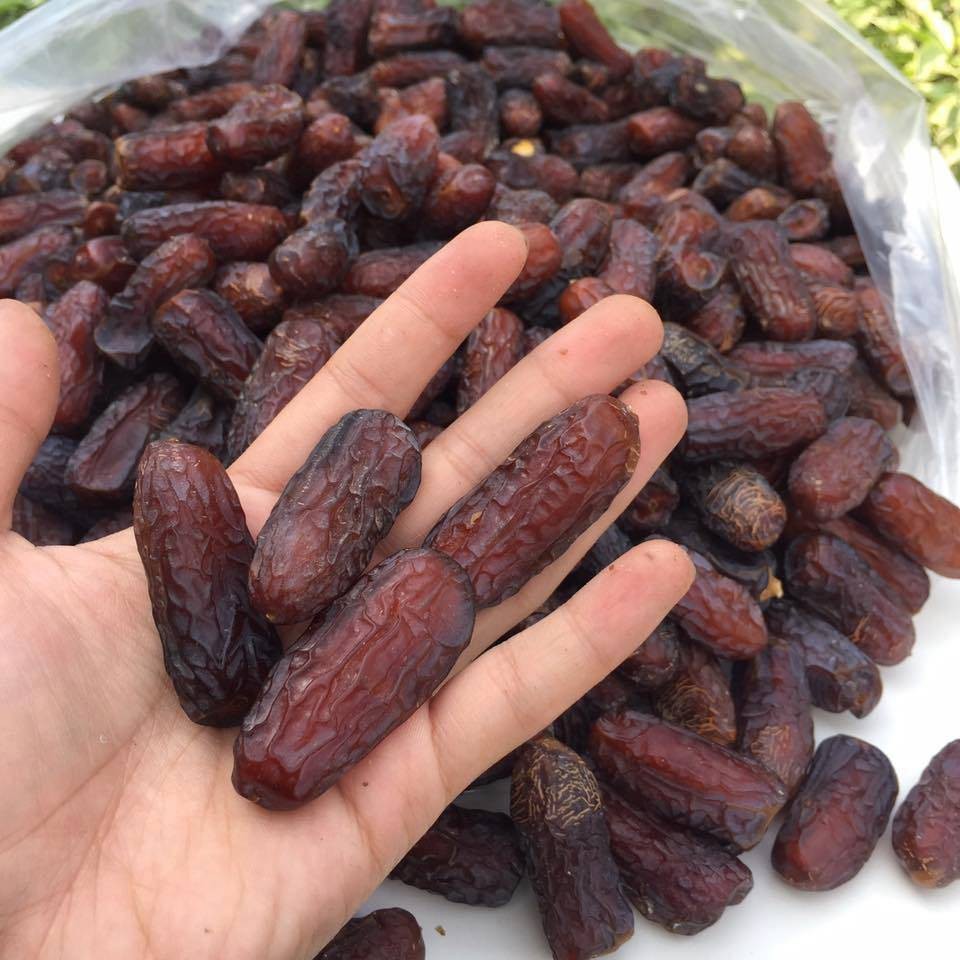
The rarer names: Barhee and Halawi
Neither of these appeared on the wholesaler list we checked.
Barhee (also spelt Barhi or Berhi) originates from Basra in Iraq, according to FAO. What makes it different is the stage at which it is eaten. FAO says the fruit at the khalal stage “has an excellent flavour, with little astringency, distinguishing it from all other date varieties”, and that “in Iraq, Israel, as well as in international commerce, Barhee is marketed and consumed only as fresh fruit on strands, at the Khalal stage.” So Barhee is normally sold fresh, before it reaches the soft rutab or the drier tamr stage.
Halawi (FAO spells it Hallawi) is in the same group. FAO lists “Barhee, Hallawi, Hayani and Zaghloul” as varieties eaten at khalal, “as they are very sweet, juicy and fibrous but not sour.” The catch is shelf life. FAO says khalal dates “will keep for only a few days without cold storage (7°C for one week or 0-1 °C for longer periods)”. If you ever find them, keep them in the fridge and eat them that week.
What a harga kurma list shows for these varieties
Here is how the varieties compare on one Malaysian wholesaler’s list, checked on 19 November 2026. Only in-stock packs are counted in the price columns. Per-kilo figures are the pack price divided by its net weight.
| Variety | Origin | Texture | In-stock packs | Per-kilo range (in stock) |
|---|---|---|---|---|
| Ajwa | Madinah, Saudi Arabia | Soft, finely wrinkled | 5 (1kg RM31 to 5kg RM175) | RM23 to RM44 |
| Safawi | Madinah region | Soft and chewy | 7 (1kg RM35 to 5kg RM195) | RM16 to RM45 |
| Mariami | Iran | Semi-dry, chewy | 4 (1kg RM40 to 5kg RM148) | RM15 to RM40 |
| Medjool | Labelled Palestine | Very soft | 5 (900g RM70 to 7.2kg RM448) | RM56 to RM77.78 |
| Deglet Noor | Tunisia / Algeria | Semi-dry | 1 (12 x 400g on the stem, RM88) | RM18.33 |
| Sukari | Al-Qassim | Rutab (soft) | 1 (3kg RM63) | RM21 |
| Mazafati | Bam, Iran | Very soft | 0 (Rotab Mazafati and Rotab BAM packs out of stock) | None in stock |
| Mabroom | Madinah region | Semi-dry, chewy | 0 (5kg AA RM230, out of stock) | None in stock |
Two things jump out. Every in-stock Medjool pack cost more per kilo than any other in-stock date pack on the list, so the best-known name was also the dearest here. And the less famous Iranian and Madinah varieties are where the low per-kilo prices sit: the Mariami A Normal 5kg at RM15 a kilo and the Safawi A No.2 (Mini) 5kg at RM16 a kilo. One Ajwa pack, the A No.2 (Mini) 5kg at RM19 a kilo, would have joined them, but it was out of stock.
On this list a 5kg pack usually came out cheaper per kilo than a 1kg pack of the same variety, but not always: the out-of-stock Ajwa Premium VIP AAA 5kg was listed at RM46.20 a kilo, above the in-stock 1kg Ajwa AAA VIP (Large) at RM44. Check the grade before you compare. Our guide to buying dates in bulk in Malaysia lines up 1kg and 5kg packs grade by grade.
Grades are each shop’s own sorting
A, AA, AAA, VIP and Jumbo are not an international standard. Each importer sorts by size its own way, so an AAA Safawi from one supplier and an AAA Safawi from another may not match. When you compare the harga kurma across shops, compare the variety, the grade name and the net weight together, and ask to see the fruit if you are buying a whole 5kg pack.
When to go looking
Demand peaks before and during Ramadan. Hari Raya, weddings (hantaran), kenduri and umrah gifts are other peaks. Gulf and Middle-East dates are mostly harvested from late summer to autumn, roughly August to November, and new-season stock reaches Malaysia some weeks later. A quiet month away from Ramadan is a good time to compare harga kurma between shops. Ask what unusual varieties a shop can get, and taste before you commit to a large pack.
Quick questions
Which variety on the list was cheapest per kilo?
Among in-stock packs on 19 November 2026, the Mariami A Normal 5kg at RM75 (RM15 a kilo). Several out-of-stock packs were listed lower per kilo.
Can I buy Barhee or Halawi in Malaysia?
Neither was on the wholesaler list we checked. Ask a shop directly, and remember FAO’s point that these are eaten fresh at the khalal stage and keep only days without cold storage.
Is Kurma Nabi a different variety from Ajwa?
No. Kurma Nabi is a Malaysian market name for Ajwa.
Trying one unfamiliar variety each time you restock is the easiest way to find a date you like at a harga kurma that suits you. More about this site is on the About Us page.